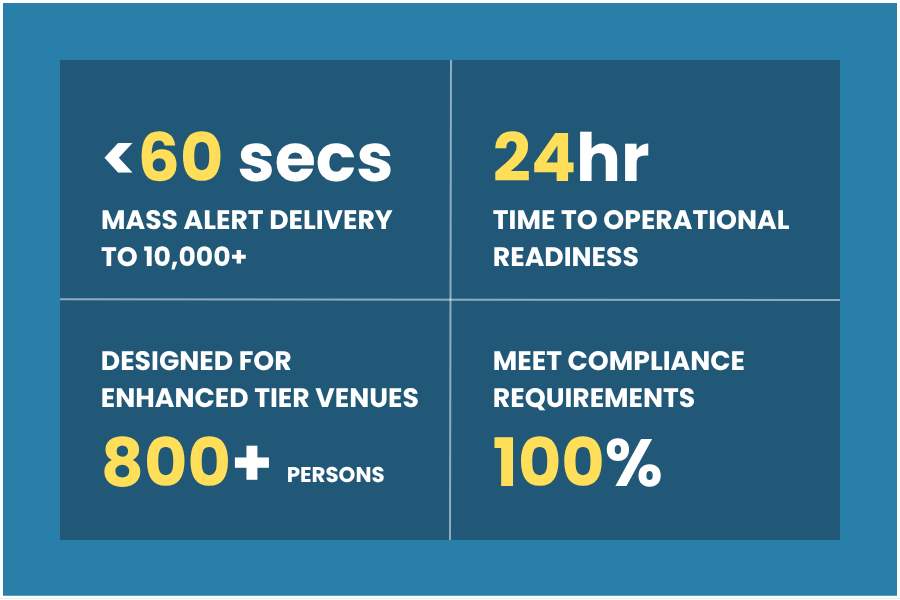
Mass SMS alerting, purpose-built for large venues and events subject to Advanced Tier compliance requirements under Martyn’s Law. Reach every visitor and staff member - inside, outside, and beyond your venue - in seconds. Operational in under 24 hours.
Evacuation signals designed for fire can drive people toward secondary devices. Sentinel delivers targeted, nuanced instructions the moment a threat is identified.
SMS reaches staff and visitors wherever they are: evacuated, dispersed, or en route. The Act requires coverage of the immediate vicinity, not just the building.
Enhanced tier venues must submit and maintain a formal compliance document. Sentinel's alert history and template library provide the evidential record.
The Act's guidance is explicit: using a fire alarm signal during a terrorist incident is inadequate and potentially dangerous. Attackers use secondary devices designed to exploit predictable evacuation patterns. Effective communication requires targeted, real-time instructions — not generic alarms.
Visitors scan a QR code or text a number on arrival - in seconds. No app install. All staff register the same way, solving the multi-employer contact problem.
One click triggers a pre-configured SMS to all contacts. Lockdown, invacuation, or evacuation - mapped to the Act's four statutory procedures.
Send follow-on instructions as the incident develops. Reach people already evacuated - outside the venue perimeter - where PA systems cannot.
A controlled all-clear message supports safe return. Managed dispersal, not a surge. Every alert is logged for your compliance document.
Communication procedures required. Documentation recommended. No formal SIA submission.
Evacuation, invacuation, lockdown & communication procedures
Staff awareness of their roles
Notify SIA of responsible person
All standard requirements, plus formal public protection measures, a mandatory compliance document, SIA submission, and a designated senior individual.
Monitoring, movement controls & physical security measures
Mandatory compliance document - submitted to SIA
30-day review window on material change
Designated senior individual - named, accountable
Also applies to qualifying events at any venue
The government has emphasised that Martyn's Law doesn't require expensive consultants or complex technology. That's true at the standard tier — and deliberately so. A venue with 250 people can meet its obligations with well-drilled procedures and a clear plan.
But at the enhanced tier, the statutory guidance changes in substance, not just degree. The obligations shift from "have a plan" to "have a system, document it, submit it, maintain it, and be personally accountable for it."
We're not positioning Sentinel as the only path to compliance. We're saying: at 800+, the gap between a plausible plan and a genuinely operational communication procedure is significant - and that gap is where Sentinel sits.
The guidance does not suggest fire alarms are inadequate - it explains why they are dangerous. This is a substantive compliance argument, not a product claim.
They cannot reach evacuated visitors, multi-employer staff, or people in the immediate vicinity after an incident. The Act specifically requires communication beyond the premises.
Caterers, AV teams, security, medical — none of these share a contact system with the event organiser. QR-based registration solves this frictionlessly.
"We have a communication procedure" is an assertion. An alert log with timestamps, recipient counts, and exercised templates is evidence. The SIA will ask for the latter.
Personal liability concentrates the mind. A named individual accountable for compliance will want to know the procedure is real, tested, and documented — not just written up in a plan.
| STATUATORY REQUIREMENT | WHY IT'S HARD WITHOUT THE RIGHT SYSTEM | HOW SENTINEL ADDRESSES IT |
| S.5(3)(D) Communication procedure - reach everyone, including immediate vicinity | PA systems are fixed-point. They cannot reach people who have evacuated, are outside, or are working for other organisations in the venue. Multi-employer events have no single contact database. | SMS via QR code registration reaches every person who has registered - regardless of their employer, location, or whether they're still inside. Covers the immediate vicinity the Act specifically requires. |
| S.5 Procedures must be implemented rapidly and effectively | The guidance is explicit: a written procedure that cannot be implemented rapidly is insufficient. Staff must have the tools available, not just the instructions. | Pre-configured templates for each procedure type. One-click dispatch in under 60 seconds. Accessible from any device, from anywhere. |
| S.6 Public protection measures — monitoring and movement controls | Enhanced tier venues must document how they monitor who is on site and how they control movement during an incident. This requires both knowing who is present and having a mechanism to reach them. | Registration data shows who is on site. Alert history records when communications were sent and to how many people. API integration with access systems can confirm who is present at the time of an incident. |
| S.6 + S10 Compliance document - submitted to SIA, reviewed within 30 days of change | The compliance document must describe how your communication procedure achieves its objectives. Without a system that creates a record, you're relying on memory or informal notes that won't satisfy the SIA. | Full alert log with timestamps, recipient counts, and template records. Provides the evidential layer for your compliance document. Unchanged configuration means no 30-day review triggered. |
| S.10 Senior individual - personally accountable for compliance | A named individual is now personally accountable. They need assurance that the communication procedure is genuinely operational and maintainable - not just documented in a plan no one exercises. | Provides the senior individual with a demonstrable, exercisable system. Drills can be run, alerts tested, and records reviewed - giving real confidence that the procedure works, not just that a plan exists. |
| S.8 Co-ordination across multiple responsible persons | Shopping centres, campuses, and large events often have multiple responsible persons. Procedures must be co-ordinated. A siloed system in one building cannot cover the whole qualifying premises. | Sentinel can operate across a shared venue, with different operator consoles feeding a unified alert pool. Co-ordinated communication without requiring everyone to share a single system. |
| GDPR Data handling - mobile numbers retained only as long as necessary | Collecting visitor phone numbers creates data obligations. Retained numbers that are not deleted create liability — and may deter registration if visitors don't trust how their data is handled. | Auto-erasure after a venue-configured window. No other personal data collected. GDPR-compliant from day one. Reduces friction at registration. |
Visitors and multi-employer staff register in seconds - no app, no friction at the gate.
Proven delivery at scale. Every registered contact receives the alert simultaneously.
Lockdown, evacuation, invacuation, all clear - built for compliance & ready to trigger.
Operates outside internal systems. For when primary infrastructure is compromised.
Trigger alerts from desktop, tablet, or mobile - from anywhere on or off site.
Full record supports enhanced-tier SIA compliance documents and internal review.
Mobile numbers auto-delete after a configurable window. No residual data risk.
Enforced 2FA prevents unauthorised access. Protecting your visitor alerting system.
Certified to the current standard. Strict information security protocols throughout.
YUDU Sentinel is a multi-award-winning provider with a strong commitment to meeting strict standards, backed by key industry accreditations.
Whether you're managing a Enhanced Tier Venue or a Qualifying Event, Sentinel gives you the communication procedure your compliance requires - deployed fast, documented automatically, and ready when it matters.